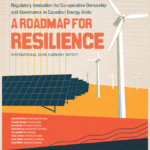
Community Energy Cooperative Canada, Royal Roads University and many other collaborators are proud to announce the release of the international scan summary report.
Community and co-operative ownership of energy infrastructure is a growing trend worldwide, as citizens and policymakers seek to ensure energy transitions are both just and resilient. The report investigates how community and co-operative ownership models can accelerate Canada’s energy transition while promoting equity, resilience, and democratic participation.
Drawing on international case studies of projects and policies from Denmark, Germany, the United Kingdom, the United States, Australia, and Aotearoa New Zealand, it identifies regulatory innovations and policy supports that enable communities to own and manage distributed energy resources (DERs) and smart-grid infrastructure. Ownership of energy infrastructure directly influences the inclusiveness, pace, and direction of energy transitions. Worldwide, thousands of community and co-operative projects already play pivotal roles in renewable power generation, heating, storage, distribution, and efficiency.
The report concludes that a coordinated Canadian approach combining enabling legislation, investment incentives, and long-term capacity-building could unlock the transformative potential of community and co-operative energy in delivering just, democratic, and resilient energy transitions.
This report is part of the project Regulatory Innovation for Co-operative Ownership and Governance in Canadian Energy Grids: A Road-Map for Resilience. Funding for this research was provided by Natural Resources Canada under the Energy Innovation Program – Smart Grid Regulatory Innovation Capacity Building Call for Proposals.