What the world’s leading community energy models can teach Canada’s clean energy transition.
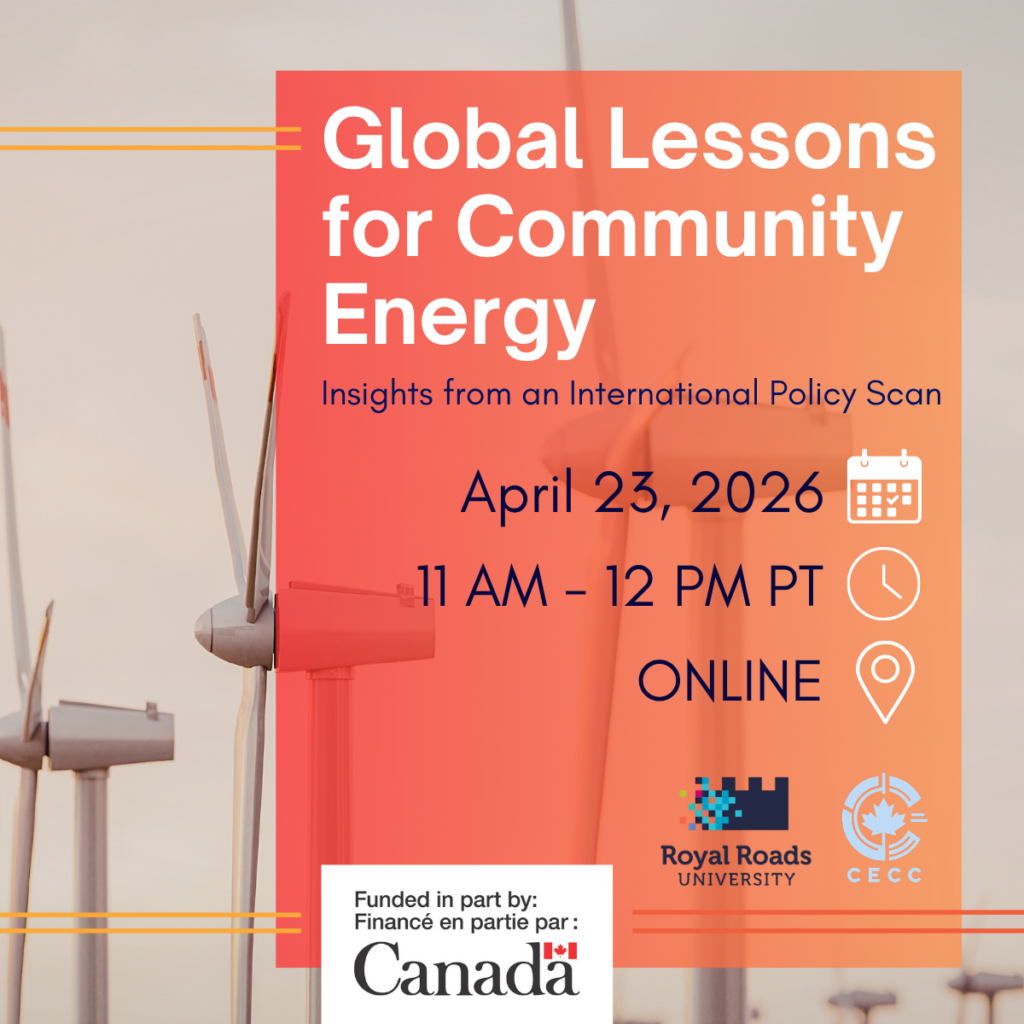
Community Energy Cooperative Canada (CECC), in collaboration with Royal Roads University and project partners, invites you to a webinar panel discussing the findings of a newly released international report on community and co-operative energy ownership.
As countries around the world accelerate their transition to renewable energy, community and co-operative ownership models are emerging as powerful tools for building more equitable, resilient, and democratic energy systems. This report examines how policy frameworks and regulatory innovations are enabling communities to participate directly in energy ownership and governance.
Drawing on case studies from Denmark, Germany, the United Kingdom, the United States, Australia, and New Zealand, the research highlights how supportive policies, financing tools, and capacity-building initiatives are enabling communities to own and manage distributed energy resources and smart-grid infrastructure.
During this webinar, a panel of researchers will:
- Present the key findings from the international policy scan
- Highlight innovative regulatory and governance models from global case studies
- Discuss the implications for community and co-operative energy development in Canada
- Explore how coordinated policies and investment could unlock the transformative potential of community energy
This research forms part of the project Regulatory Innovation for Co-operative Ownership and Governance in Canadian Energy Grids: A Road-Map for Resilience, supported by Natural Resources Canada through the Energy Innovation Program – Smart Grid Regulatory Innovation Capacity Building Call for Proposals.
This session is designed for policymakers, researchers, community energy leaders, and anyone interested in the future of community-owned renewable energy in Canada.
PRESENTERS:
Julie MacArthur – Royal Roads University – Professor and Canada Research Chair in Reimagining Capitalism
Dr Julie MacArthur is an Associate Professor and the Canada Research Chair in Reimagining Capitalism at Royal Roads University and Resident Fellow in Energy Systems Transformation at the Cascade Institute. Her SSHRC and Royal Society (New Zealand) funded research investigates the political economy of low carbon transitions, with a particular focus on how grassroots and community-led initiatives can scale up to make radical democratic and transformative impacts to
both adaptation and mitigation. She has published widely on community energy initiatives in Canada and Aotearoa New Zealand, on participatory policy design, Green New Deal politics, and the gendered employment trends across energy sub-sectors. She is the author of Empowering Electricity: Co-operatives, Sustainability and Power Sector Reform in Canada (UBC 2016), co-editor of Environmental Politics and Policy in Aotearoa New Zealand (University of Auckland 2022).
Khaoula Bengezi – York University – PhD Candidate
Khaoula Bengezi is a PhD candidate at the Department of Politics and a graduate associate at the Centre for Feminist Research at York University. Currently, Khaoula is researching global responses to climate change in the Sahara Desert through renewable energy transitions vis-à-vis clean energy technologies. She is particularly interested in examining how environmental expertise are constructed, legitimized and articulated in sustainable development projects in North Africa through a multi-scalar case study approach. Her work centres the experiences of local small-scale farmers, particularly women and how the construction of climate mitigation technologies have affected their ability to survive in the desert. Khaoula’s approaches are informed by an array of intersecting interdisciplinary approaches including global environmental governance, critical science and technology scholarship and decolonial political ecology. Moreover, for the past three years she has been the program coordinator for Righting Relations Hamilton, a movement of adult educators and community organizers who work towards decolonization and social change on Turtle Island.
Chad Walker – Assistant Professor – Dalhousie University
Chad Walker is an interdisciplinary environmental social scientist and Assistant Professor of Low-Carbon Transitions at Dalhousie University. There, he holds a faculty position in the School of Planning and is cross-appointed with the School for Resource and Environmental Studies. Chad is also a Research Associate in Geography at the University of Exeter (UK).
Josie Ward – Project Coordinator – NorQuest College
Josie Ward is a project coordinator at NorQuest College and the University of Saskatchewan, where she combines her expertise in sustainable development and renewable energy. She holds a Master of Environment and Sustainability from the University of Saskatchewan, where her research focused on leveraging renewable energy projects to advance community development. She also holds a Master of West Nordic Studies, Governance, and Sustainable Management from the University of the Faroe Islands. Her current research involves evaluating provincial policies to advance renewable energy cooperatives, with the goal of developing policy frameworks that support sustainable, community-driven energy initiatives.

This project is funded in part by the Government of Canada’s Low Carbon Economy Fund Implementation Readiness stream
Ce projet est financé en partie par le volet Préparation à la mise en œuvre du Fonds pour une économie à faibles émissions de carbone du gouvernement du Canada.