October 8–9, 2026
Concordia University, Montréal, Québec | Hybrid Event | In-person registration SOLD OUT | Virtual registration FREE
Registration & Pricing
~ In-Person Registration is Sold Out ~
Thank you for the strong response to the 2026 Community Energy Forum. In-person registration is now sold out.
~ Virtual Registration is Still Available ~
Join the Forum online on October 8–9, 2026. Virtual registration is free and provides access to the Forum’s online sessions.
Registered virtual participants will receive access information for the online sessions. The Forum will use one Zoom link for the main event, with separate virtual attendance details provided to CECC members for the Annual General Meeting.
Live translation will be available through LiveVoice, with translated captions and live audio interpretation in English and French.
Forum Program
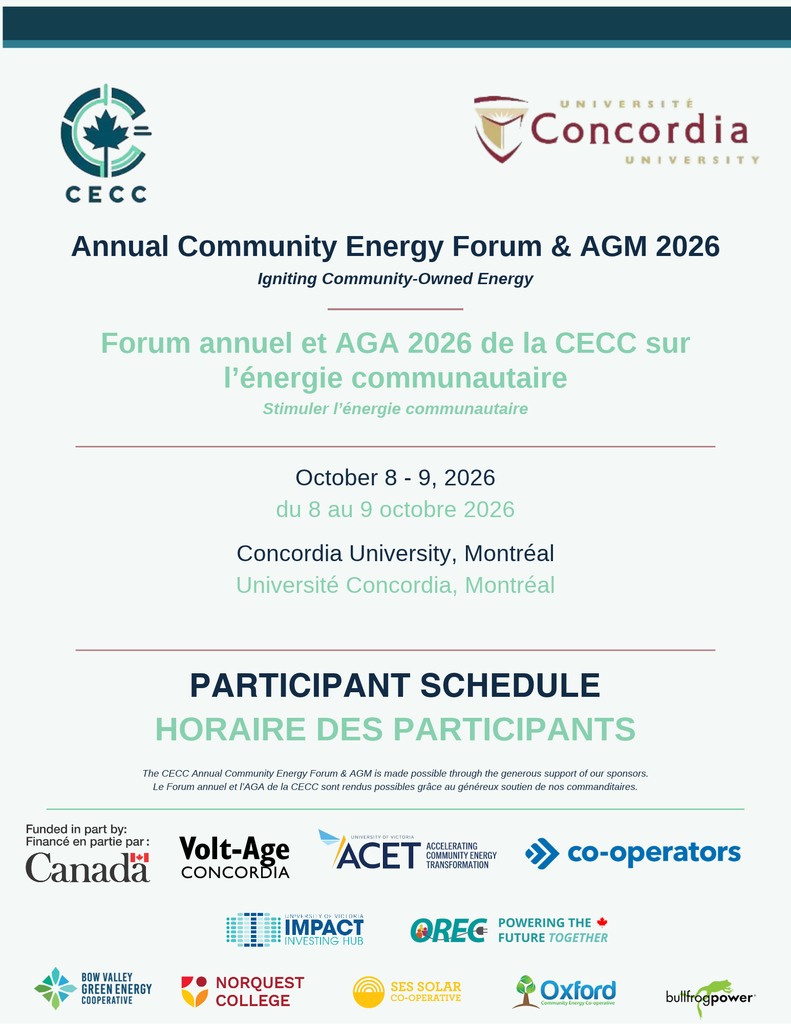
The full 2026 Community Energy Forum program is now available, including the complete schedule, session descriptions, speakers, and participant information.
Bringing Together Canada’s Community Energy Movement
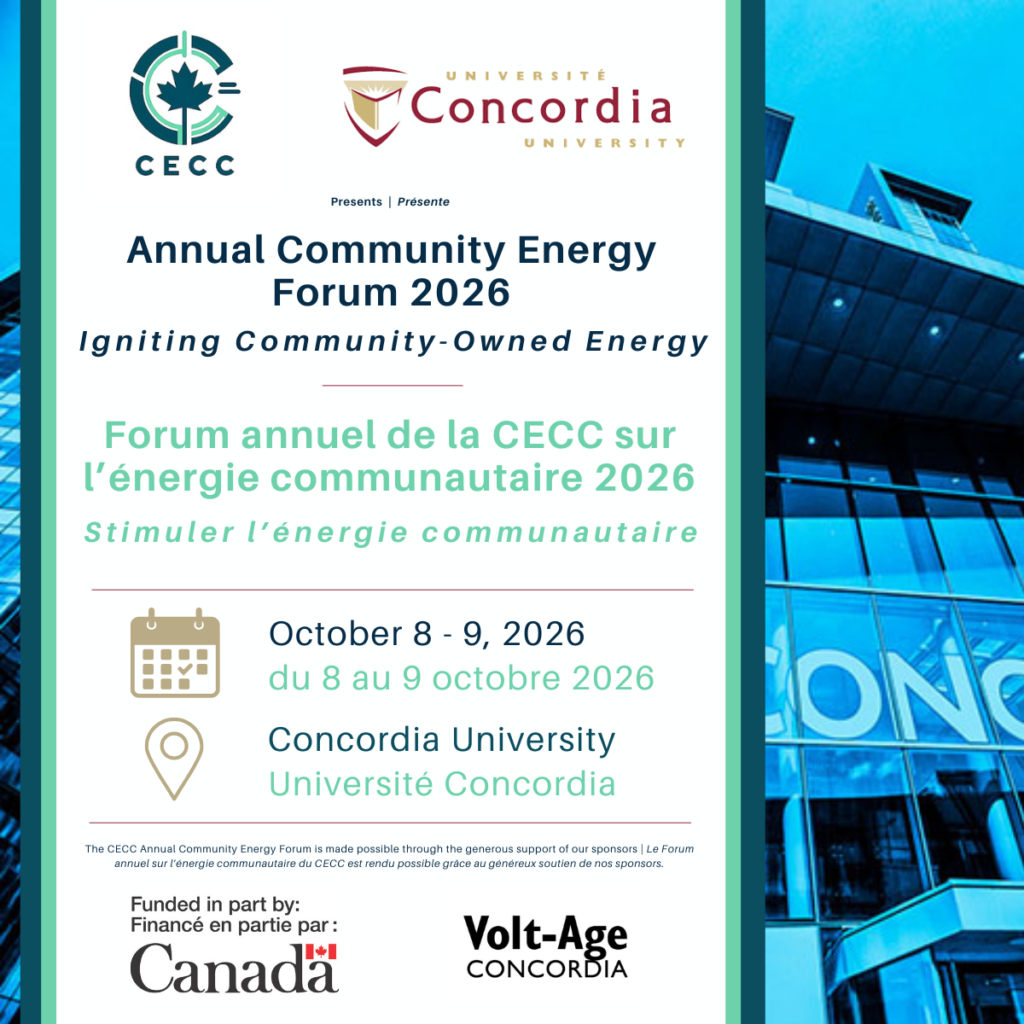
Hosted by Community Energy Cooperative Canada (CECC), the Annual Community Energy Forum is Canada’s national gathering dedicated to advancing community-owned renewable energy. This bilingual forum showcases innovative projects, emerging policy, financing solutions, governance models, and practical tools that help communities build and own renewable energy projects. Over two days, participants will exchange ideas, develop partnerships, and explore how community energy can become a cornerstone of Canada’s energy transition.
You’ll connect with:
- Renewable energy co-operatives
- Indigenous community leaders
- Municipal governments
- Researchers and academic institutions
- Policymakers
- Utilities and industry partners
- Financial institutions
- Social economy organizations
- Community energy practitioners
What To Expect
Participants will explore:
- Innovative financing and investment models
- Renewable energy co-operative governance
- National and provincial policy developments
- Indigenous-led community energy initiatives
- Community ownership models
- Practical pathways to developing new energy co-operatives
- Networking opportunities with leaders from across Canada and internationally
Opening Keynote Speaker
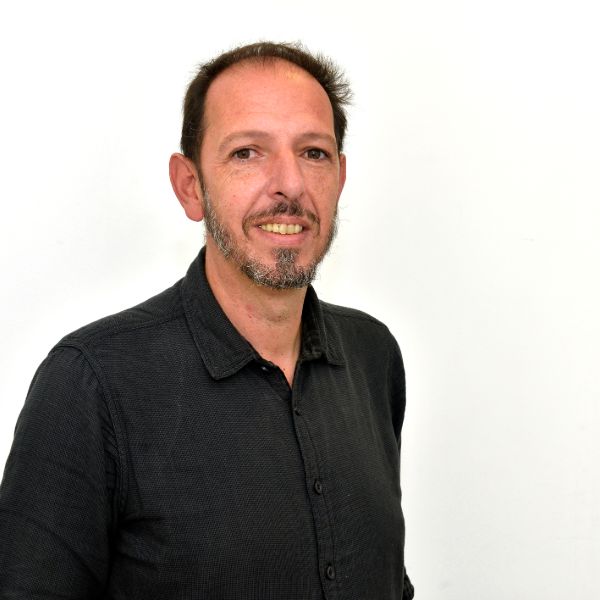
Dr. Jordi Pascual, PhD
Senior Consultant, Institut de Recerca en Energia de Catalunya
Energy Communities and Cooperatives in Catalonia and Europe
Dr. Jordi Pascual will share international lessons from the rapid growth of energy communities across Catalonia and Europe, highlighting successful ownership models, enabling policy frameworks, and practical approaches that can help accelerate community energy development in Canada.
Dr. Jordi Pascual, PhD Biography
Jordi Pascual (Dr, m) obtained his degree in physics, with a specialty in astrophysics, at the Universitat de Barcelona in 1995. Thereafter, during 1995 – 1997, he was a professor at the faculties of engineering at Universidad San Carlos and Universidad Rafael Landívar in Guatemala. After that, during the period 1998 – 1999, he worked as an ERP consultant at Advanced Oriented Technologies. In 1999, he holds a Postgraduate in energy systems at the Universitat Politècnica de Catalunya, and during 2000 – 2001, he studied a Master’s degree in Design and management of Renewable Energy systems at Institut Català de la Tecnologia. In 2000, he founded AIGUASOL, an energy consultancy and engineering firm, where he served as Technical and marketing team manager, General manager, and Senior consultant on EE and RES projects during different periods until 2019. In parallel, during 2008-2015, he holds a Doctorate in Sustainability, Technology and Humanism from the Universitat Politècnica de Catalunya. In 2014 he founded the AIGUASOL spinoff Exsergy efficiency, dedicated to buildings EE ESCO operations, and served until 2019 as Technical main manager. In 2019, he joined the IREC staff as a senior researcher (R3) in the Thermal Energy and Building Performance (ECOS) Group. With 25 years of wide experience on consultancy projects, during the last years, he has been proposing and/or participating in several EU-funded research projects, as GiDomus, LOCALISED, EUCLID, SEACAP4SDG, Efficient Buildings, Syn.ikia, Plural, Mednice, Houseful, Plug&Harvest, 4RinEU, Integridy, GrowSmarter, and so on, and other national or regional R+D projects, mainly related to building physics, energy efficiency and renewable energy systems.
Featured Keynote Speaker
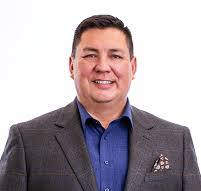
Guy Lonechild
Indigenous communities are playing an increasingly important role in shaping Canada’s energy future, from developing renewable energy projects and community energy plans to building new models for ownership, investment, and participation in the energy sector.
Drawing on his experience leading the First Nations Power Authority and working with First Nation communities, governments, utilities, and industry, Guy Lonechild will explore what Indigenous leadership can mean in practice as communities navigate the changing energy landscape. He will speak to the opportunities and challenges involved in moving from participation to meaningful economic ownership, building community capacity, and ensuring that energy development delivers lasting benefits for Indigenous communities.
The keynote will consider the broader role of Indigenous communities in Canada’s energy transition and the potential for community-owned and Indigenous-led approaches to create greater energy security, economic opportunity, and local decision-making. It will also offer perspectives on where renewable energy co-operatives and other community energy organizations can contribute to this work.
Guy Lonechild Biography
Guy Lonechild is a well-known advocate for enabling growth and leading energy transformation pathway opportunities for First Nation communities in Canada and serves as President and CEO of First Nations Power Authority.
Mr. Lonechild serves on Bruce Power’s New Nuclear Advisory Panel, as chair of the Indigenous Advisory Council on New Nuclear, served as co-chair of Natural Resource Canada’s SMR Leadership Table, and as Indigenous Relations advisor to OPG’s New Nuclear Review Board. His area of interest is Indigenous rightsholder, public and stakeholder engagement, innovations for development in new nuclear, renewables, project finance, and Indigenous-led power procurement initiatives in the Canadian electricity sector.
Recognized as a solution-oriented leader, Mr. Lonechild advocates for economic and environmental reconciliation as a path forward for stakeholders to harness the potential in
alternative energy and supply chain opportunities that generate lasting benefits for Indigenous communities. He currently serves as board member of the Energy Council of Canada (ECC), Clean Energy Association of British Columbia (CEBC), and holds a Master of Business Administration from Cape Breton University and is a former leader of the Federation of Saskatchewan Indian Nations.
Workshop Program
A Roadmap to Resilience for Community Energy in Canada
In this interactive session, the Roadmap to Resilience project team will share findings from their year-long exploration of resilience in Canada’s renewable energy co-operative sector. Through research into international best practices, a regulatory scan of all provinces, and workshops with stakeholders in six locations across the country, they have identified key opportunities and challenges shaping the future of community energy in Canada.
The session will highlight lessons learned and explore priority areas for building a more resilient renewable energy co-operative sector. Participants will then take part in facilitated small-group discussions to reflect on the findings, explore shared challenges and opportunities, and consider how the sector can work more closely together while maintaining local relevance. The discussions will also provide input into the development of provincial roadmaps, helping ensure they reflect the unique needs, opportunities, and priorities of communities across Canada.
Featured speakers
Dr. Martin Boucher, PhD – Dean of Research – NorQuest College
Daniel Curwin – Volt-Age Doctoral Fellow & Project Manager – Next-Generation Cities Institute, Concordia University
Josie Ward – Project Coordinator – Canadian Centre for the Study of Co-operatives (CCSC), University of Saskatchewan
Maya Willard-Stepan – Research Fellow, ACET Project – University of Victoria
How Can More Participatory Energy-Planning Processes and Energy Communities Be Developed in Québec in 2026?
Comment mettre sur pied des processus de planification énergétique plus participatifs et des communautés d’énergie au Québec en 2026?
Alors que le Québec se prépare à une transformation majeure de son système énergétique, les communautés locales, les citoyens, les coopératives et les organisations de la société civile demeurent seulement marginalement impliqués dans la définition des besoins, l’établissement des priorités, la sélection des projets et la gouvernance des infrastructures. Pourtant, les expériences au Québec et à l’étranger démontrent que la production, la distribution et la consommation d’énergie peuvent être planifiées et organisées différemment. Les processus délibératifs, les initiatives de planification territoriale, les coopératives, les microréseaux et les projets détenus collectivement offrent différentes voies pour renforcer la participation communautaire et le pouvoir décisionnel.
Ce panel examinera les possibilités pratiques de faire progresser ces approches dans le contexte institutionnel et politique actuel du Québec. Comment les communautés et les citoyens peuvent-ils devenir plus directement impliqués dans la planification énergétique ? Que pourrait signifier une communauté énergétique au Québec en 2026 ? Quels rôles pourraient jouer les coopératives, les municipalités, Hydro-Québec, la Régie de l’énergie et les mouvements citoyens ? Quels obstacles réglementaires, institutionnels, financiers et organisationnels limitent actuellement de telles initiatives ?
Featured speakers
Karl Janelle – PhD Researcher & Lecturer in Sustainable Transition – HEC Montréal
Damien Tholomier – General Manager & CEO – Coopérative d’électricité de Saint-Jean-Baptiste
Alexandre Rechnitzer – Economic Regulation Specialist – Régie de l’énergie
Rachel Fahlman – President – Vent d’élus
Gaëlle Crête – Co-operative and Mutual Intelligence Advisor – Conseil québécois de la Coopération et de la Mutualité (CQCM)
Benoit Delage – Executive Director – Conseil régional de l’environnement et du développement durable de l’Outaouais (CREDDO)
Financing and Owning the Energy Transition
Community-owned energy projects can bring lasting local benefits, but securing the capital to build them is still one of the sector’s biggest challenges. This panel brings together three perspectives on that challenge: research, co-operative practice, and lending.
Dr. Basma Majerbi (University of Victoria) will share findings from a national survey on community energy finance, including results for co-operatives, and introduce the Community Energy Finance Navigator. Jodi Conuel (Bow Valley Green Energy Cooperative) and John Kirkwood (Ottawa Renewable Energy Co-operative) will describe how their co-ops have raised member capital, built partnerships, and adapted their financing models to different provincial markets. This includes Ontario’s shift away from feed-in tariffs and new partnership models with housing authorities. Joost Sluis (Desjardins) will explain what lenders look for in a financeable project, which financing tools are available at different project scales, and how financial institutions can better support the renewable energy co-op sector.
Moderated by Dr. Ursula Eicker (Next Generation Cities Institute, Concordia University), the discussion will cover how policy, market structure, and utility relationships shape the way community projects are financed and owned. Attendees will leave with practical insights into how to structure, finance, and scale community-led energy projects in different regulatory contexts across Canada.
Featured speakers
Prof. Dr. Ursula Eicker, PhD – Canada Excellence Research Chair – Next Generation Cities Institute, Concordia University
Jodi Conuel – Founder & Director – Bow Valley Green Energy Cooperative
Joost Sluis, CFA – Director, Infrastructure and Energy Transition, Desjardins
John Kirkwood – President – Ottawa Renewable Energy Cooperative
Dr. Basma Majerbi, PhD – Founder & Director – UVic Impact Investing Hub
Indigenous Leadership, Community Energy and Renewable Energy Co-operatives
Indigenous-led and Indigenous-partnered community energy projects are creating new opportunities for local ownership, economic participation, community decision-making, and greater energy independence. Drawing on experience from Haida Gwaii and other communities across Canada, this session will explore practical approaches to Indigenous community energy development, including how projects are initiated, structured, financed, and developed in ways that support Indigenous leadership and long-term community benefit.
Speakers will share perspectives on Indigenous leadership, economic development, youth engagement, and the opportunities and challenges involved in developing community-owned energy projects. Examples from Haida Gwaii will highlight the development of Indigenous-owned renewable energy projects, the role of local investment and participation, and the technical and regulatory challenges that can shape what is possible in smaller and remote communities. The session will also consider the broader potential for community energy co-operatives to contribute to Indigenous-led energy development.
The discussion will explore practical lessons from projects underway and the different ways co-operatives and Indigenous communities can work together, including through project development, community investment, capacity building, knowledge sharing, and shared ownership models. It will also consider how renewable energy co-operatives can support Indigenous communities while respecting Indigenous leadership, priorities, and decision-making authority.
Featured speakers
Darcie Lanthier – Director & Co-Founder – Energy Democracy Now Co-operative
Kuan Jian Foo – Founder & Principal Energy Advisor – BIA Energy Consulting – representing Tll Yahda Energy
Tomika Pinay – Indigenous Economic Development Specialist – Government of Saskatchewan
Gavin Jackson – Engineering Department Lead – Green Cat Renewables Canada Corporation
Dr. Mariia Iakovleva, PhD – Post-Doctoral Fellow, ACET Project – University of Victoria
The Role of the Municipal Ecosystem in Enabling Community Renewable Energy Co-operatives
Community renewable energy projects often depend on a broader municipal ecosystem of local governments, economic development organizations, researchers, community groups, and co-operatives. Each can play a different role in identifying opportunities, building local capacity, navigating processes, and connecting projects to community priorities.
Drawing on experience in municipal climate and energy planning, community energy development, economic development, and energy equity, Janice Ashworth of Dunsky, Dany Robidoux of Éco-Ouest Canada, and Dr. Derya Tarhan of the University of Guelph will explore how these actors can work together to support community-owned energy. Examples will include municipal energy planning, community renewable energy development, and Guelph’s Energy Equity Action Plan.
The discussion will consider practical ways co-operatives can engage municipalities and regional partners, what different organizations can contribute, and how projects can move from early ideas and local priorities toward implementation and long-term community benefit.
Featured speakers
Prof. Julie MacArthur, PhD – Canada Research Chair in Reimagining Capitalism – Royal Roads University
Dany Robidoux – Executive Director, Éco-Ouest Canada / Eco-West Canada
Janice Ashworth – Senior Consultant – Dunsky Energy + Climate Advisors
Dr. Derya Tarhan, PhD – Assistant Professor, School of Environmental Design and Rural Development – University of Guelph
Thank You To Our Sponsors
The CECC Annual Community Energy Forum is made possible through the generous support of our sponsors.
Presenting Sponsor:

Funded in part by the Government of Canada’s Low Carbon Economy Fund, with special thanks to Environment and Climate Change Canada for their support.
Gold Sponsors:
This research was undertaken thanks in part to funding from the Canada First Research Excellence Fund, awarded through the Volt-Age initiative at Concordia University.
Silver Sponsors:

Community Partners:
Forum Supporters:
~ sponsorship opportunities are now closed ~
Sustainability Partners:
The 2026 Community Energy Forum is bullfrogpowered® with 100% green electricity.
This means that Bullfrog Power’s generators put 100% green electricity onto the grid to match the amount of conventional electricity the event uses, displacing energy from polluting sources. Across Canada, Bullfrog’s green electricity comes from a blend of wind, solar, and low-impact hydro power sourced from new Canadian renewable energy facilities. For more information on Bullfrog’s green energy, visit bullfrogpower.com.
CECC Annual General Meeting (AGM)
The Community Energy Cooperative Canada (CECC) 2026 Annual General Meeting (AGM) will also be hosted as part of this year’s Forum.
The AGM is an opportunity for members to come together to review the past year, provide input, and help shape the organization’s future direction. Members will receive updates on CECC’s activities and impact, review financial statements, and participate in key governance decisions, including board elections and strategic priorities.
If you are interested in supporting and shaping this work, we invite you to become a CECC member and take part in both the Forum and AGM.
AGM Details
October 9, 2026 | 4:00 PM – 5:00 PM
Concordia University, Montréal, QC (Hybrid: In-person & Online)
CECC Members registered to attend the Forum in person are warmly invited to participate in the AGM on-site.